Our assessment
AXP fell 0.76% over the November 3, 2026 regular session, ending at USD 325.50. Revenue, credit and per-share profit support a measured purchase around 18.3× trailing EPS, with affluent spending and credit still cyclical.
Research updated November 4, 2026; historical price references end at the November 3 regular-session close.
What happened to the share price
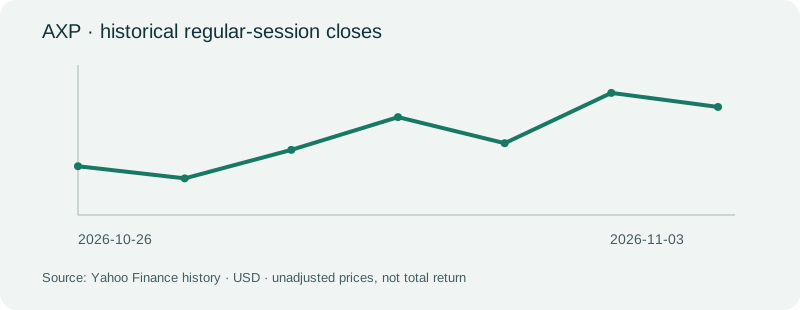
AXP finished November 3 at USD 325.50, compared with USD 327.98 at the previous close. Its daily return was -0.76% and five-session return was +4.02%. A positive session can still sit inside a weaker five-session path, just as a daily fall can follow a strong run. These are saved historical regular-session prices, not live quotes or dividend-inclusive total returns.
Q3 earnings and controlled credit support the premium franchise
October 23 results reported $20.062 billion of net revenue, $3.712 billion of net income and 1.8% net write-offs. The latest operating evidence is dated 2026-10-23, for 2026-09-30. It is relevant to the business outlook, but the price data alone does not establish a single cause of the move.
Does the move make the stock worth buying?
The valuation supports a selective purchase while retaining consumer and credit-cycle risks. At $325.50, build gradually; the premium customer base supports resilience but does not remove recession risk.
A lower price needs a stronger return case
Quarterly credit provision was approximately $1.0 billion, below the prior year's $1.3 billion, and the net write-off rate was 1.8% versus 1.9%. Reserve effects contribute to the comparison, so I would not assume the entire profit increase is repeatable operating leverage. Unlike a network-only exposure, American Express bears lending risk. A downturn can weaken spending and increase losses together, even with a higher-income customer base. Premium spending may be more resilient than some mass-market categories, but customers can still reduce travel or discretionary purchases. Credit losses also tend to respond with a lag, so a healthy current write-off rate is not a guarantee for the next economic phase.
The financial evidence behind this view
Latest verified report: American Express Q3 FY2026, published 2026-10-23. Measures retain their stated accounting basis and reporting periods.
| Reported measure | Value and period | Comparison and meaning |
|---|---|---|
| Reported revenue | USD 20.062 billion 2026-07-01/2026-09-30 |
USD 18.426 billion (2025-07-01/2025-09-30). +8.88% change. Reported period value; comparison uses the corresponding prior-year reporting period where available. Source |
| Reported GAAP net income / loss | USD 3.712 billion 2026-07-01/2026-09-30 |
USD 2.902 billion (2025-07-01/2025-09-30). +27.91% change. Reported period value; comparison uses the corresponding prior-year reporting period where available. Source |
| Net interest income | USD 4.940 billion 2026-07-01/2026-09-30 |
USD 4.486 billion (2025-07-01/2025-09-30). +10.12% change. Reported period value; comparison uses the corresponding prior-year reporting period where available. Source |
| Reported equity | USD 35.797 billion 2026-09-30 |
Balance-sheet amount at the stated date; not a quarterly flow. Source |
What the valuation does and does not say
$325.50 / ($15.38 FY2025 diluted EPS + $14.22 nine-month 2026 – $11.85 nine-month 2025).
Trailing profit includes reserve effects. Management's $18.30-$18.60 annual EPS guidance is a separate forward measure.
Frequently asked questions
Did AXP actually fall over this window?
It fell 0.76% over the November 3, 2026 regular session. The daily and five-session comparisons are shown separately.
Would this price move alone change the investment conclusion?
Revenue, credit and per-share profit support a measured purchase around 18.3× trailing EPS, with affluent spending and credit still cyclical.
What would make a new purchase more convincing?
At $325.50, build gradually; the premium customer base supports resilience but does not remove recession risk.
Discuss the investment case
Join the existing WhatsApp research discussion to compare the business case, valuation and risks. Group participation does not guarantee returns or access to personalized advice.
Sources
Investment opinion for general education, not personalized financial advice. Capital is at risk. Financial observations are dated; estimates and hypothetical examples do not guarantee future returns.